
Advertisement
How to Play Pyramid Solitaire
Pyramid Solitaire is a classic one-player card game where you pair exposed cards that add up to 13 to clear a 28-card pyramid. It’s the same Pyramid solitaire you may remember from the Microsoft Solitaire Collection on Windows, or from the decks your parents and grandparents played on the kitchen table. The pyramid card game has been around since at least the 1800s, and it has stayed popular because the rules are simple, a round is short, and every deal is different. You can play our free Pyramid Solitaire above — no download, no signup, no ads blocking the cards.
Game Setup
Pyramid Solitaire uses a standard 52-card deck — no Jokers. The dealer shuffles the deck and lays out 28 cards face up in a pyramid shape: 1 card on top, then 2, 3, 4, 5, 6, and finally 7 cards on the bottom row. Each row overlaps the row below by about half a card, so only the bottom row of seven cards is fully exposed when the game begins. The cards above are blocked until the two cards beneath them are removed.
The remaining 24 cards form the stock pile, placed face down to one side of the pyramid. Next to the stock sits an empty spot for the waste pile— cards you’ve flipped from the stock but haven’t paired yet. A third empty spot, the foundation, holds cards that have been removed from play. Our version shows the most recently cleared card on the foundation so you can see your progress at a glance.
On a physical table, setup takes about a minute. In a web browser it happens instantly the moment you click New Game. Because every pyramid card game is dealt randomly, no two rounds play the same — you’ll learn to recognize winnable layouts over time.
How Cards Match in Pyramid Solitaire
The core rule is simple: any two exposed cards whose ranks add up to exactly 13 can be removed as a pair. Number cards count as their face value; the face cards have fixed point values. Here’s the full pairing table:
| Card | Value | Pairs With |
|---|---|---|
| Ace | 1 | Queen (12) |
| 2 | 2 | Jack (11) |
| 3 | 3 | 10 |
| 4 | 4 | 9 |
| 5 | 5 | 8 |
| 6 | 6 | 7 |
| King | 13 | Removed alone |
Kings are the only card worth 13 by themselves, so they never need a partner. Every other pair adds to 13 exactly: 1+12, 2+11, 3+10, 4+9, 5+8, and 6+7. Suits don’t matter — a red 7 pairs with a black 6 just as well as two of the same color.
How to Play Pyramid Solitaire
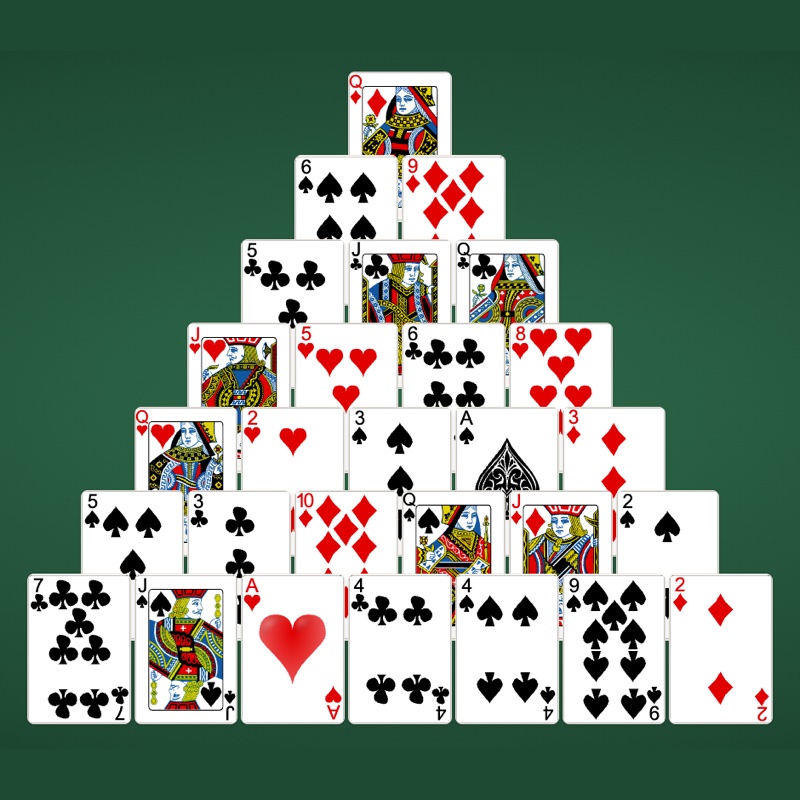
Once the pyramid is dealt, your goal is to clear every card. Here’s how a typical round plays out:
- Set up the pyramidDeal 28 cards face up in a pyramid shape — 1 card on top, then 2, 3, 4, 5, 6, and 7 cards on the bottom row. Each row overlaps the row below, so only the bottom row is fully exposed at the start. The remaining 24 cards form the stock pile.
- Find pairs that add to 13Look for two exposed cards whose values add to exactly 13. Aces count as 1, number cards are face value, Jacks are 11, and Queens are 12. Click both cards to remove them.
- Remove Kings on sightKings have a value of 13 by themselves. Click any exposed King to remove it immediately — no pairing required. Always clear Kings early to unblock the cards beneath them.
- Use the stock pile when stuckWhen no more pyramid pairs are available, click the stock pile to flip a card to the waste pile. The waste-pile top card can pair with any exposed pyramid card that sums to 13.
- Win by clearing the pyramidYou win when all 28 pyramid cards have been removed. You can cycle through the stock pile up to three times. After the third pass, remaining cards lock in.
In our version you can also drag a card onto its partner instead of clicking twice — whichever feels more natural. The undo button lets you reverse a move if you change your mind, which is handy for learning the game. None of these aids change the underlying Pyramid solitaire rules; they just make the controls comfortable.
Pyramid Solitaire Rules
The full Pyramid solitaire rules come down to a handful of clear principles. Most beginner mistakes come from forgetting one of them, so it’s worth reading these once before you play:
- Only exposed cards can move. A card is exposed when nothing is on top of it. The bottom row is always exposed at the start; higher rows unlock as you clear the ones below.
- Pairs must add to exactly 13.No “close enough.” 6+7 works; 6+8 doesn’t.
- Kings remove alone. Click any exposed King to remove it on its own.
- One stock card at a time. Clicking the stock flips a single card face up to the waste pile. Only the top waste card is available to pair.
- Three passes through the stock.When the stock is empty you can recycle the waste back into the stock up to two more times (three total passes). After the third pass, any cards you haven’t paired are locked out.
- You can’t move cards within the pyramid. Cards leave the pyramid only by being paired or removed as a King — you never shuffle them around on the table.
For complete rules, edge cases, and answers to tricky situations (like what happens when two Kings are exposed at once), see our Pyramid Solitaire Rules guide.
Why People Still Play the Pyramid Card Game
Pyramid as a pyramid card game traces back to at least the Victorian era, when one-player card solitaires were a popular evening pastime. It stayed in circulation through the 20th century because a full round takes under ten minutes, the equipment is nothing but a single deck, and the rules are easy to teach a child or remember into old age.
When Microsoft shipped Solitaire with Windows in the early 1990s and later added the pyramid card game to the Solitaire Collection, millions of office workers and retirees picked it up during breaks. Today most people search for how to play Pyramid Solitaire online because they want the same familiar game without the Microsoft account, tutorial pop-ups, or app downloads that came with later Windows versions. That’s exactly what this site offers — just the classic pyramid card game, free and ready to play.
Pyramid Solitaire Tips & Strategies
Pyramid Solitaire is part luck and part planning. These Pyramid solitaire tips come from years of play and will noticeably improve your win rate, especially on layouts that look stuck at first glance.
1. Clear Kings immediately
Every King you leave in the pyramid blocks the two cards beneath it. Four trapped Kings will almost always cost you the game, since the cards they’re sitting on can’t be removed until the King moves.
2. Work from both sides of the pyramid
Don’t concentrate your matches on one corner. If you strip the right side of the pyramid clean while ignoring the left, the upper-left cards end up buried with no partners. Try to keep both sides advancing in parallel.
3. Delay the stock pile
The stock is a limited resource — you only get three passes. Match as many pyramid pairs as you can before you start drawing, so you arrive at the stock pile already needing fewer cards.
4. Watch for “dead” pairs
If both 6s of a given suit are visible in row 6 of the pyramid, and both 7s are buried in row 2, you’ll need the stock pile to save the layout. Scan early for these traps so you know when to save your stock cards for specific matches.
5. Count what’s still missing
When you’re stuck, think about which ranks you still need. If you’re holding a 4 in the waste pile and no 9 is visible, you’ll need to draw until a 9 appears. Prioritizing the pyramid cards that will partner with already-visible stock cards is often the difference between winning and a near-miss.
Frequently Asked Questions
Quick answers to the questions new players ask most often. The full rules page covers more edge cases.
How hard is Pyramid Solitaire?
Pyramid Solitaire is considered easier than Klondike. Studies of large game samples show approximately 30% of random Pyramid games are winnable, and the win rate improves significantly with good strategy. The most common reason for losing is unmatched cards trapped under blockages at the top of the pyramid.
How many times can you cycle the stock pile in Pyramid Solitaire?
In our standard game you can cycle the stock pile up to 3 times. After the third pass, any remaining cards lock in and become unavailable. Strict Las Vegas variants allow only 1 pass through the stock, which makes the game significantly harder.
What happens when you see a King in Pyramid Solitaire?
Kings have a value of 13, so they can be removed from the pyramid by themselves with a single click — no pairing required. Always remove Kings as soon as they become available. Leaving a King in place blocks every card beneath it, and four trapped Kings will almost always cost you the game.
Can you play Pyramid Solitaire on mobile?
Yes. Our Pyramid Solitaire works in any modern mobile browser — iPhone, iPad, or Android — without downloading anything. The cards automatically resize for phone and tablet screens, and you can play in portrait or landscape. No app or account required.
Is this the same as Microsoft Pyramid Solitaire?
The rules are the same as the Pyramid game in Microsoft Solitaire Collection: pair exposed cards that add up to 13, remove Kings on their own, and clear the 28-card pyramid. Our version runs in any web browser with no Microsoft account or Windows installation required.
Pyramid Solitaire for Senior Players
Many of our regular players are in their 60s, 70s, and 80s, and we built this site with their feedback in mind. If you’re used to the AARP Pyramid Solitaire page or the Pyramid game on older versions of Windows, you’ll feel at home here.
Why Pyramid suits older players
Unlike Klondike, which rewards chains of long-range moves, Pyramid Solitaire is mostly about pattern recognition — finding pairs that sum to 13. The rounds are short (five to ten minutes each), the rules are steady across decades of play, and there are no surprises from update to update.
Comfort features built in
- Large, high-contrast cards. Big pips and clear rank letters — no squinting.
- No account, no install. The game works the moment the page loads, on a phone, tablet, laptop, or desktop.
- Red or blue card backs.Pick the look that’s easiest on your eyes under the Appearance menu.
- Undo and Hint buttons. If you miss a match or get stuck, help is one click away.
A gentle brain workout
Card games like Pyramid Solitaire give your short-term memory and pattern recognition a light, enjoyable workout. They’re no substitute for other forms of mental activity, but a daily round is a pleasant habit that costs nothing and asks nothing. If you play duplicate bridge or other strategy card games, you’ll find Pyramid a relaxing change of pace — less thinking ahead, more satisfying little puzzles in a row.
Playing together
Pyramid is a solitaire game, but that doesn’t mean you have to play alone. Many of our regulars play alongside a grandchild or a friend, taking turns choosing matches and talking through the decisions out loud. It’s a gentle way to share time with someone, and a good excuse to pass an afternoon without screens pulling everyone in different directions. If someone in your family has never tried Pyramid Solitaire, open the game up on a laptop and walk them through it — it takes maybe five minutes to explain and a lifetime to tire of.
Prefer a version tuned specifically for older eyes and hands? Play our Easy Pyramid Solitaire for Seniors — extra-large high-contrast cards, one simple rule, and no clock. For a fuller guide — including what to look for in a card game for an older player, research on card games and brain health, and the other games we’re planning to add — see our Card Games for Seniors page.
More Ways to Play

Ready to Play Pyramid Solitaire?
Scroll back to the top or click below. Every deal is free, no signup, no ads over the cards.